

He’d had his annual physical the week before coming in.
His doctor ran labs. Everything was “in range.” He was cleared for another year. He left feeling vaguely disappointed but not sure why.
Two months later, at a functional medicine clinic, a full intake panel told a different story. His vitamin D was critically low. His testosterone was at the bottom edge of normal for a man his age. His thyroid was converting hormones poorly. His inflammatory markers were elevated.
None of these had shown up because none of them had been tested.
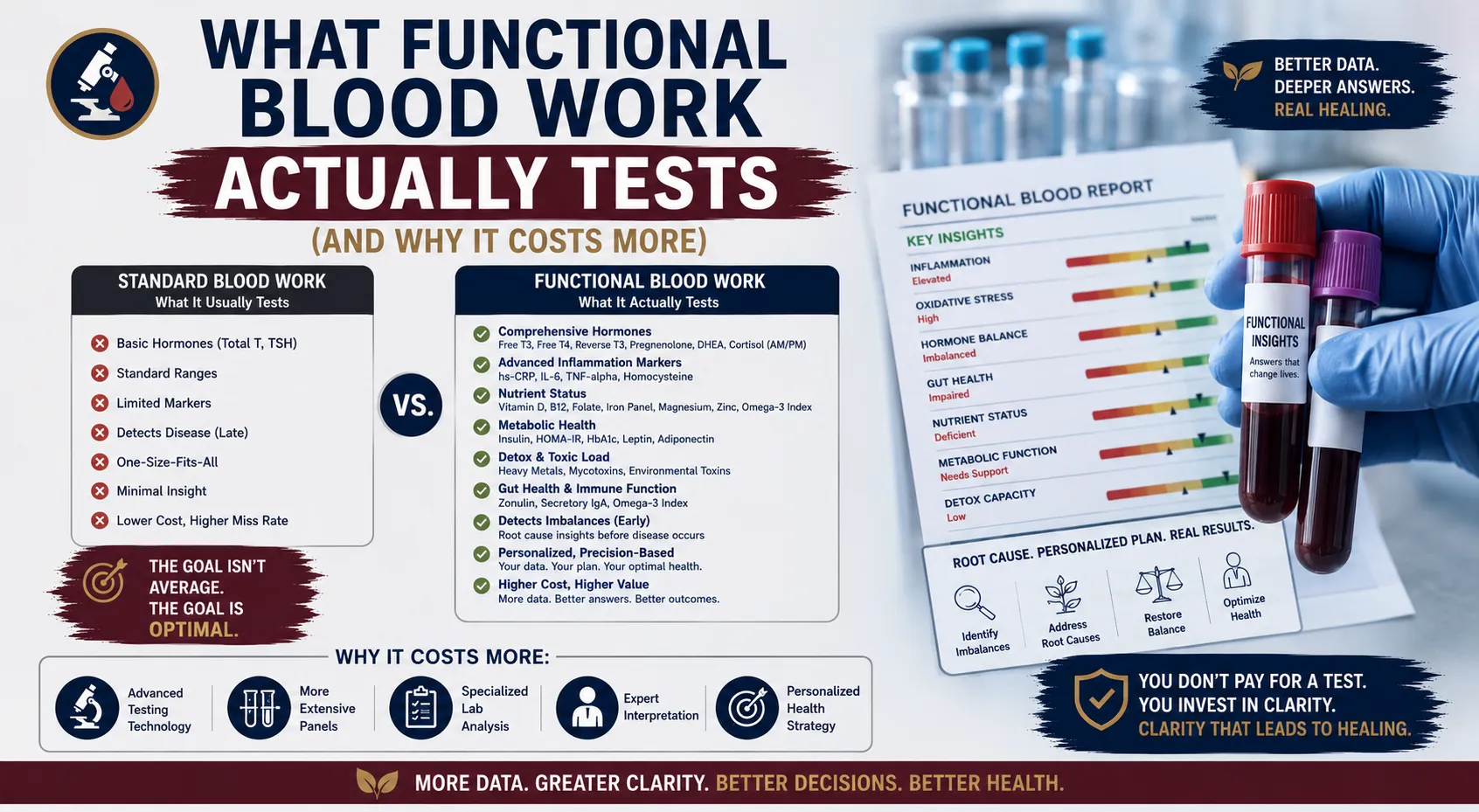
This happens constantly. And when patients ask why functional medicine blood work costs more, the shortest answer is: because it’s measuring more of what actually matters.
The Annual Physical Panel Is a Screening Tool
The standard annual panel is designed to catch disease.
It’s a complete blood count, a basic metabolic panel, maybe a fasting lipid panel. These tests tell a provider whether you’re anemic, whether your kidneys and liver have obvious dysfunction, whether your blood sugar and electrolytes are in range, and whether your cholesterol pattern looks like a cardiovascular risk.
They’re useful for what they’re designed to do. They will catch a diabetic patient whose blood sugar has been in dangerous territory. They’ll flag kidney disease, anemia, and liver dysfunction.
What they won’t catch is the space between sick and thriving. The person whose body is working but not working well. The person whose hormone levels have been declining for three years but haven’t yet crossed the threshold that triggers a diagnosis. The person whose thyroid isn’t converting efficiently, whose gut is inflamed, whose nutrient stores are depleted, and who’s been told repeatedly that they’re fine.
What a Functional Intake Panel Actually Includes
A functional medicine initial panel starts where the standard panel ends.
It includes the standard screening markers plus a comprehensive picture of hormone function, thyroid status, nutrient levels, adrenal function, and cardiovascular risk markers beyond basic cholesterol.
Hormone panel. Sex hormones: testosterone (total and free), estradiol, progesterone (in women), DHEA-S, and sometimes additional markers depending on the clinical picture. These affect energy, body composition, mood, cognition, bone density, and cardiovascular risk. They’re routinely not checked in standard primary care.
Full thyroid panel. Not just TSH. TSH tells you what the brain is signaling to the thyroid. It doesn’t tell you how much hormone the thyroid is actually producing (free T4 and total T4), how much active thyroid hormone the body is generating through conversion (free T3), whether the body is producing an inactive blocking form (reverse T3), or whether the immune system is attacking the thyroid (TPO antibodies, thyroglobulin antibodies). Each of these markers tells a different piece of the story. Ordering only TSH is like reading one chapter of a book and summarizing the entire plot.
Nutrient levels. Vitamin D, B12, magnesium, iron (with iron saturation and ferritin), and CoQ10. These are the raw materials for energy production, immune function, hormonal activity, and cellular repair. Most of them are not part of standard care. Many patients are meaningfully deficient in at least one without knowing it.
Cardiac and metabolic markers. Beyond a lipid panel, this includes inflammatory markers like high-sensitivity CRP, homocysteine, and sometimes advanced lipoprotein testing. These provide a more granular picture of cardiovascular risk than total cholesterol alone.
Adrenal and cortisol staging. Often assessed via salivary testing that maps the cortisol curve across the day, not a single blood draw that captures only one moment. The full cortisol graph shows whether the patient’s stress hormone system is in its first stage (chronically elevated), a disrupted stage (high when it should be low, low when it should be high), or the burnout stage (chronically depleted).
Colin Renaud, DC, PA-C explains why the comprehensive picture matters: “We’re assessing cardiac risk, hormone dysfunction, thyroid issues, nutrient levels. These are things just not done routinely by anyone in the medical system. There’s so much data that we’re gathering about the different metrics of the patient, and it’s really invaluable from the very beginning.”
Why Insurance Won’t Cover Most of This
Insurance companies structure reimbursement around conventional treatment algorithms. The logic is circular: we pay for tests that inform treatments we also pay for. If the test doesn’t change the insured treatment, we don’t pay for the test.
Here’s how this plays out with the thyroid:
The conventional treatment for hypothyroidism is levothyroxine. Levothyroxine is managed by monitoring TSH. If TSH is in range, the treatment is working, by the conventional standard. Running a full thyroid panel, including antibodies and conversion markers, wouldn’t change the levothyroxine prescription. So insurance doesn’t cover it.
The same logic applies across the board. If there’s no covered medication that changes based on the test result, there’s no covered test.
This isn’t a conspiracy. It’s a system built around pharmaceutical management of diagnosed conditions, not comprehensive assessment of patient function. The problem is that this structure creates a ceiling on what care looks like.
As one patient’s experience illustrates: her doctor said “I don’t believe in hormone testing” when she asked to have her levels checked at 42. She was experiencing significant cognitive and physical changes consistent with perimenopause. There was no covered intervention the doctor could offer based on hormone levels that weren’t already at a diagnostic threshold. So the test was declined.
She came to a functional medicine clinic and got answers that day.
Reference Ranges Versus Optimal Ranges
This is one of the most important distinctions patients need to understand.
Reference ranges on lab results are derived from population statistics. If a large enough portion of the population has low vitamin D, the average level becomes the reference range. A patient at that average is technically “normal.” They are also functionally deficient.
Functional medicine uses optimal ranges. Not “is this value above the disease threshold?” but “is this value where it needs to be for this patient to function well?”
The difference is significant. Optimal vitamin D is around 70 to 80 ng/mL. The reference range floor is 30. A patient with a vitamin D of 32 will be told their level is normal. Their immune system is not functioning at capacity. Their thyroid conversion may be impaired. Their inflammation may be elevated. They’re technically in range. They’re not optimized.
This matters practically. A patient with a vitamin D of 4, which has been documented in patients with severe immune dysfunction, will be told their vitamin D is “critically low” by any standard. But a patient at 32 will often be told “you’re fine” while experiencing real functional consequences of insufficiency.
Running comprehensive labs and interpreting them against optimal rather than reference ranges is why functional medicine can find answers that conventional labs didn’t surface. The tests are the same. The questions being asked of the results are different.
What Happens When You Actually Have a Blueprint
One of the structural advantages of comprehensive intake testing is timing. When a provider sees a patient for their first appointment, the labs are already back.
In conventional medicine, a first appointment often produces a referral for tests that come back at a second appointment weeks later, which then produces a treatment trial, followed by a follow-up appointment to assess results. The patient waits months to get started.
When comprehensive labs precede the first appointment, the provider can begin addressing identified deficiencies immediately. The first treatment session starts on day one, not at month three.
Colin Renaud, DC, PA-C describes the advantage: “We can get people started on their very first treatment or their very first appointment. The blood work really sets the tone of treatment and it’s so comprehensive in what we’re doing.”
The Cost Question
Functional medicine blood work costs more because more gets measured. That’s the honest answer.
But the framing is incomplete if the comparison stops there.
The patient who spends three years cycling through specialists, collecting prescriptions that address symptoms without touching causes, paying copays at every appointment, and still not feeling better has also spent money. A lot of it. Along with time, energy, and the compounding cost of being unwell.
Comprehensive upfront testing that identifies the actual drivers, whether that’s low testosterone, insufficient thyroid conversion, vitamin D deficiency, or an autoimmune process that’s been running for years, can shorten that cycle considerably.
It’s not cheap to look at everything at once. It’s also not cheap to look at nothing and keep returning to specialists for years.
About the Author: This article was written by the clinical education team at Med Matrix, a functional medicine clinic in South Portland, Maine. Med Matrix serves over 3,000 patients with a provider team that specializes in root-cause testing, hormone optimization, and personalized treatment plans.